



rochelle2026-04-19T21:08:12+00:00
You’re running ads. You’re showing up at networking events. You’ve got a team answering inquiries. And yet, at the end of the month, the revenue doesn’t reflect the effort. Sound familiar?
For most service-based businesses, the problem isn’t a lack of leads. It’s what happens, or doesn’t happen, after a lead comes in. Leads go cold. Follow-ups get dropped. Estimates go unanswered. And with every missed touchpoint, potential revenue quietly walks out the door.
This is the gap that Sales Pipeline Stabilization is designed to close.
In this guide, we’ll break down why lead inconsistency happens, what a stabilized pipeline actually looks like, and how businesses like yours can stop losing money in the space between interest and commitment.
The Real Reason Your Leads Are Inconsistent
Most business owners assume that inconsistent revenue means they need more leads. More ads. More outreach. More visibility. But before spending another dollar on lead generation, it’s worth asking a more honest question: what’s happening to the leads you already have?
The Signs Your Pipeline Is Unstable
An unstable pipeline doesn’t always look like a slow month. Sometimes it looks like a packed schedule with nothing to show for it at the end. Here’s what to watch for:
- Leads come in but rarely convert to paying clients
- Deals are stalling, not moving through the stages in a timely way
- You’re busy with client work, then suddenly scrambling for new business
- Revenue swings month to month without a clear pattern
If any of these feel familiar, the issue isn’t your marketing. It’s your pipeline infrastructure.
The Most Common Causes of Lead Inconsistency
Relying on Too Few Lead Sources
When most of your leads come from a single channel, referrals, one networking partner, or a single ad campaign, your pipeline becomes fragile. The moment that source slows down, everything slows down with it.
Marketing Only When You Feel the Pressure
Many businesses market reactively. When the pipeline gets thin, they ramp up activity. When things get busy, they pull back. This creates the “feast or famine” cycle that keeps revenue unpredictable. Consistency in visibility builds consistency in leads, not urgency-driven bursts.
Sales and Marketing Working Independently
Marketing may be generating interest, but if the sales process is weak, slow, or undefined, that interest won’t convert. Lead flow feels inconsistent not because leads aren’t coming in, but because too few of them become real opportunities.
A Message That’s Too Broad
When your messaging tries to speak to everyone, it resonates with no one. Unclear positioning brings in attention, but not qualified attention. The leads you attract matter as much as the volume.
Weak or Absent Follow-Up
Research consistently shows that most deals close after five or more touchpoints. Yet most businesses follow up once, maybe twice, and then move on. Warm leads don’t disappear overnight, they go cold when no one stays in contact.
No Lead Nurture System
Not every prospect is ready to buy today. Without a structured nurture track, email sequences, check-in calls, retargeting, “not yet” leads fall through the cracks entirely. The business loses what could have been a future client simply because there was no system to stay in front of them.
Stopping Business Development While Doing Client Work
This one is especially common in service businesses. You win clients, shift focus entirely to delivery, and pause all outreach. By the time the work wraps up, the pipeline is empty and you’re starting from scratch. Someone always needs to be cultivating the next opportunity, even when you’re fully booked.
“More marketing is not always the answer. You have to identify the problem before throwing more money at it and hoping for different results.”
What Missed Follow-Ups Are Really Costing You
Here’s a practical way to think about the financial impact of poor follow-up. Imagine you have five prospects, each worth $5,000. You successfully close three of them, but you stop following up on the last two before they’re ready to commit. That’s $10,000 left on the table in a single month.
Multiply that across twelve months, and you’re looking at $120,000 in missed revenue per year, not from lack of leads, but from lack of follow-through.
Beyond the revenue loss, inconsistent follow-up sends a message to prospects. It signals that their business isn’t a priority. It can damage referral relationships. And it can give potential clients a preview of what working with you might actually feel like.
What Is Sales Pipeline Stabilization?
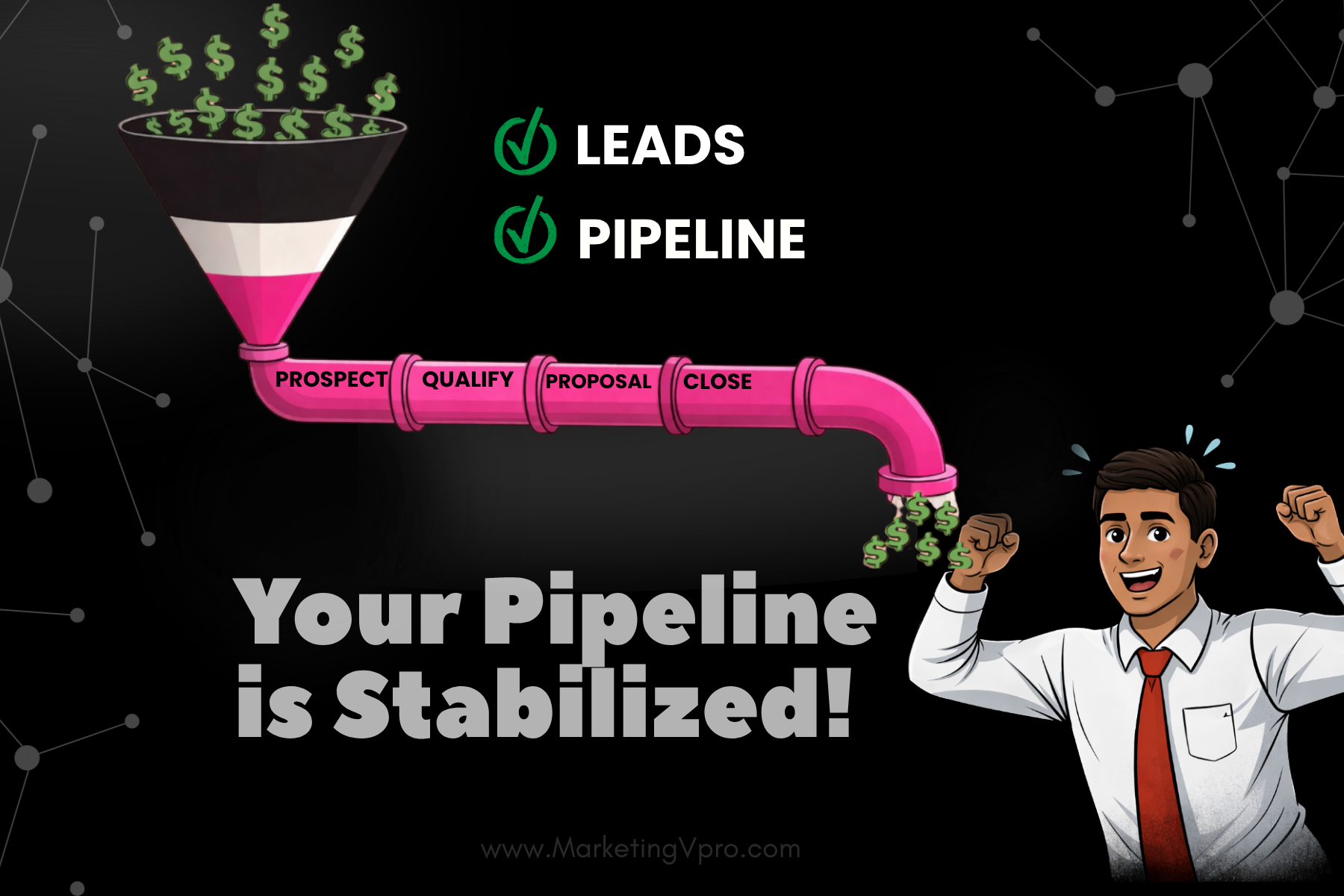
Sales pipeline stabilization is the process of ensuring consistent, intentional movement of prospective clients through your sales process, from the moment they express interest to the moment they sign on.
It’s not lead generation. Lead generation gets people to raise their hand. Pipeline stabilization ensures that once a hand is raised, it’s never ignored.
How It Differs from Traditional Lead Generation
Lead generation is about getting prospects in the door. Sales pipeline stabilization is about what happens after they walk in. The two have to work together, but confusing one for the other is one of the most expensive mistakes a service business can make.
Traditional marketing agencies, the kind that run ads, manage social media, and design websites, focus on volume. They optimize for clicks, impressions, and inquiries. What they don’t control is the speed of your response, the quality of your follow-up conversation, or the reason a prospect didn’t convert. They generate leads but don’t own the outcome.
Sales pipeline stabilization focuses on conversion infrastructure: the systems, processes, and people skills that turn interest into revenue.
What Problems It Solves
- No clear map of the sales process, or what should happen at each stage to strengthen your position
- Weak or nonexistent follow-up, where leads go cold because no one has ownership
- Dormant contact lists with no re-engagement strategy
- Staff members who follow up but lack the sales training to guide a meaningful conversation
- No SOPs for handling leads consistently across the team
Who Needs This Most
If your business is spending money to generate leads, through ads, trade shows, or any form of outreach, but you’re not converting those leads at the rate you should be, you need a stabilized pipeline before you need more marketing.
This is especially true if:
- An assistant or office manager handles initial follow-up but doesn’t have a sales background
- The owner is still the primary closer and is stretched thin
- There’s no consistent process for handling leads from inquiry to close
Which Industries Benefit Most
While sales pipeline stabilization isn’t industry-specific, it’s problem-specific, some industries see the greatest impact because of how they operate:
Home Services (Painting, Roofing, HVAC, Plumbing, Remodeling, Landscaping)
These businesses typically spend heavily on ads, have high inbound lead volume, and rely on an assistant or office manager who may not have a strong sales background. The owner is often embedded in the sales process and delivery simultaneously. They don’t need more leads, they need a better system for converting the ones they’re already receiving.
Local Logistics Services (Moving, Hauling, Junk Removal, Restoration)
These businesses live and die by response speed. The first company to follow up often wins the job. Poor follow-up doesn’t just lose a lead, it loses a job that someone else is ready to pay for today. When operators are running the work, the sales process is often the first thing that gets neglected.
Inside a Sales Pipeline Stabilization System
Understanding the problem is one thing. Knowing what a solution actually looks like, what it includes, how it’s structured, and what it asks of your team, is what turns insight into action.
The Three Core Components
- Fortifying the Sales Follow-Up for Hot Leads
The immediate priority is ensuring that active, high-intent leads don’t fall through the cracks. This means mapping out exactly what should happen, and when, from the moment a lead comes in to the moment they become a client.
- Mining the Contact List for New Opportunities
Most businesses are sitting on a dormant goldmine: past clients, previous inquiries, and contacts who expressed interest but never moved forward. Opportunity mining is the process of using engagement data to identify who in your existing list may be ready to hear from you, and reaching out with intention rather than a mass blast.
- Aligning Conversation and Operations
The way your team talks about your services should mirror the language your prospects see in your marketing. When messaging is misaligned between sales and marketing, trust erodes, even when both are doing their jobs well.
How Lead Categorization Works
Not all leads deserve the same urgency. A practical sales stabilization system organizes contacts into three categories:
Hot: Requests for proposals or estimates, past clients, referrals, repeat inquiries, and anyone who attended a consult, workshop, or webinar in the last 90 days.
Warm: Social media followers, email subscribers, and event attendees from the last 3–6 months.
Cold: New audiences with no prior engagement with your business.
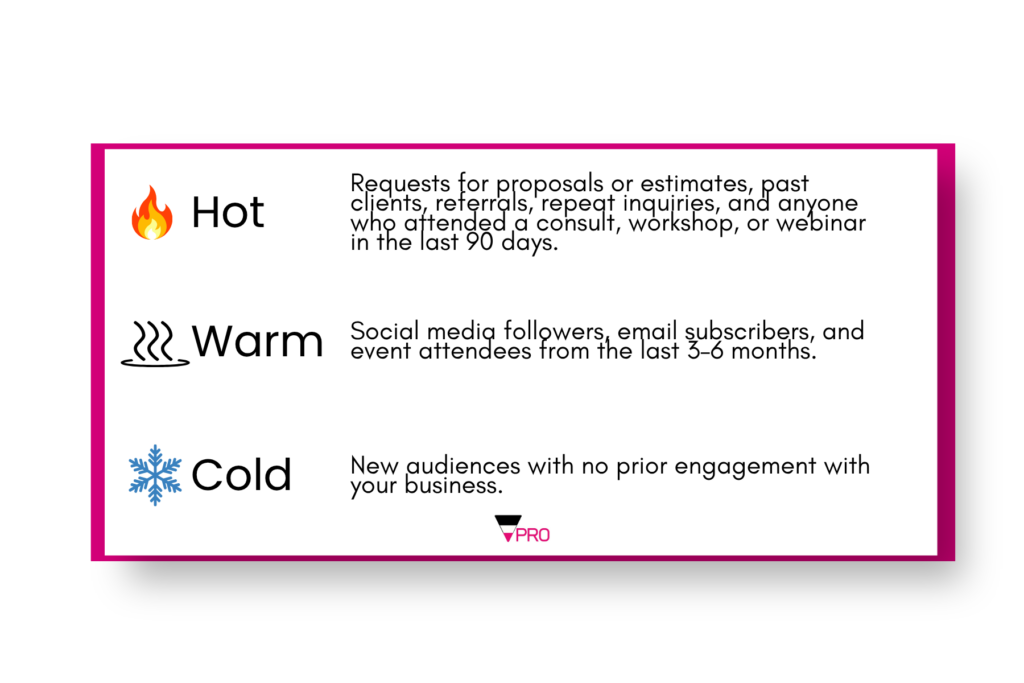
Knowing where each contact falls allows your team to prioritize outreach, personalize the message, and apply the right level of urgency, without burning through your list or exhausting your team.
The Role of the CRM
A CRM isn’t just a contact database. In a stabilized pipeline, it becomes the command center for your sales process. It organizes leads so you can easily identify who to reconnect with, sets follow-up reminders so no one slips through the cracks, and creates visibility across the entire process, so you always know the status of every active opportunity.
The most common reason CRM systems fail isn’t the technology. It’s that the business doesn’t have a clear process for the CRM to support. The tool is only as effective as the workflow behind it.
How Automation Supports the Process
Automation doesn’t replace human connection, it protects it. In a stabilized pipeline, automation handles the consistent, repeatable touchpoints that are easy to forget when you’re busy: sending a follow-up email when a lead moves to a new stage, triggering a reminder when a prospect hasn’t responded in a set number of days, or delivering nurture content to warm leads over time.
The goal is to make follow-up a reliable cadence rather than a reactive scramble.
The Power of Re-Engaging Past Clients
One of the most underutilized revenue sources in any service business is the existing client list. Past clients already trust you. They’ve experienced your work. And they may have new needs they haven’t thought to bring to you yet, or may be sitting on a referral they haven’t made because no one asked.
A systematic approach to re-engagement isn’t pushy. It’s attentive. It keeps your business top of mind for the people most likely to work with you again or refer someone they know.
What Implementation Actually Looks Like
One of the most common hesitations around any new system is uncertainty about what’s actually involved, in time, effort, and disruption to the day-to-day. Here’s what a realistic implementation looks like.
The Timeline
Weeks 1–3: Digital Sales Growth System
This is the tech foundation, CRM setup, automation configuration, lead categorization, and process mapping. It starts with a kickoff call to gather the information needed to design the system, followed by a build phase, and then a reconnect session to test the system with the point of contact.
Business owner time commitment: approximately 90 minutes for the kickoff call, 1–2 hours to provide requested information, and a 90-minute wrap-up call. The rest is handled by the implementation team.
Weeks 4–11: Sales Pipeline Stabilization Training
This is the human side of the system. Weekly 60–90-minute training sessions with the staff member responsible for follow-up, structured around real scenarios, live practice, and process alignment. The goal is to ensure that the person handling your leads has the confidence and skill to guide conversations, not just pass along information.
By the end of the training, your team member won’t just be executing a process. They’ll understand why each step matters and be actively surfacing new opportunities from within your existing contact list.
What the First 90 Days Deliver
- 30 Days: Digital sales growth system fully implemented and tested
- 60 Days: Staff member 50% through the sales pipeline stabilization training
- 90 Days: System in full use, staff member fully trained and actively improving the sales process while identifying additional revenue opportunities
What Happens After Implementation
Once the system is live and the training is complete, the business takes ownership of the process. For businesses that want ongoing support, there are options for continued oversight, including monthly marketing efforts designed to feed the stabilized pipeline rather than overwhelm an unprepared one.
The ROI of a Stabilized Pipeline
Pipeline stabilization isn’t a cost center, it’s a revenue recovery system. Here’s how to think about the return.
The Break-Even Math Is Simple
Close one additional client as a result of the training and system, and the investment pays for itself. For most service businesses, that’s not a stretch, it’s a natural outcome of following up with leads that previously would have gone unanswered.
The question isn’t whether the system works. The question is how many opportunities you’ve already let walk away.
What It’s Not Competing With
Sales pipeline stabilization isn’t an alternative to hiring a marketing employee or a salesperson. It’s the framework, the training, and the SOP that any marketing, sales, or business development person needs to have a direct impact on revenue. The two complement each other, but adding people before fixing the process often means more people repeating the same inefficiencies.
Ads vs. Follow-Up: What to Fix First
If your follow-up system is broken, running more ads accelerates the problem. You’re paying to generate leads that will enter an unorganized process and disappear. Fix the infrastructure first. Then increase the volume flowing through it.
If stewarding financial resources is important to you, and it should be, the highest-leverage move is an internal campaign to re-engage the leads you already have. That’s cash flow with no additional ad spend.
“Businesses are already spending money to generate leads, but they’re losing those opportunities in the pipeline. That’s the gap we exist to close.”
Investment
The Sales Pipeline Stabilization system is priced starts at $4,900, plus monthly system costs. Given that a single recovered client typically covers the investment, and the SOPs and training remain as permanent assets for your team, the value compounds over time.
Is This the Right Fit for Your Business?
A Good Fit If You Are…
- A service-based business receiving 10 or more leads per month
- Spending money on lead generation, ads, trade shows, traditional marketing
- Feeling like you should be closing more than you are
- Operating with an assistant or team member handling follow-up without sales training
- Experiencing inconsistent month-to-month revenue
- Holding a contact list of past clients or previous inquiries that hasn’t been touched
Not the Right Fit If You Are…
Sales Pipeline Stabilization is built for consultative, human-led sales. It’s not designed for:
- E-commerce businesses with no human conversion process
- Early-stage SaaS companies using a product-led growth model
- Restaurants or retail businesses with transactional, non-consultative sales
What If You Don’t Have Many Past Leads?
The system has two phases. Phase one, the technology setup, CRM, and automation, is valuable regardless of the size of your contact list. Phase two, which involves mining the existing list for re-engagement opportunities, requires having a list to work with. If you don’t yet have that volume, phase one still gives you the infrastructure to build on.
Small businesses are often the ideal candidate for this work, especially when the owner is still involved in the sales process but has a staff member helping who isn’t yet experienced in sales. That’s exactly the scenario this system is built for.
How Vpro Marketing Approaches This Differently
Most marketing agencies are built to generate interest. Vpro Marketing & Sales is built to convert it.
Vpro is focused on the conversion infrastructure. That means diagnosing lead handling, sales process, follow-up systems, messaging alignment, and pipeline visibility, and then building the framework to address what’s actually broken.
The work is also designed to be durable. Every system comes with SOPs, which means the process isn’t dependent on any one person. When a team member changes, the system, and the institutional knowledge behind it, stays.
Ready to Stabilize Your Pipeline?
If your leads are inconsistent, if you feel like you should be closing more, or if you suspect opportunities are slipping through the cracks of your current process, the first step is clarity.
Start by asking yourself:
- Are you receiving at least 10 or more leads per month?
- Do you feel like your close rate should be higher?
- Is your revenue inconsistent month to month, even when your activity isn’t?
If the answer to any of these is yes, a Sales Pipeline Stabilization system may be exactly what your business needs, not more marketing, but a stronger foundation for everything your marketing is already doing.
Book a Growth Readiness Call
Let’s learn about your sales process, identify the gaps, and map out what stabilization looks like for your business. Click HERE to book a a call.
